

danielrosehill/Parakeet-TDT-0.6B-v2-English-Hebrew-Codeswitching
Automatic Speech Recognition • 0.6B • Updated • 3.14k
Read-aloud sentences from one speaker, recorded on a phone (OnePlus Nord 3 5G, internal microphone).
Website: hebrish.app: get the Hebrish keyboard for Android and the desktop apps, see the results, and find every model, dataset and demo in one place.
Speaker: Daniel Rosehill, the dataset's author, who was born in Ireland and speaks English with an Irish accent, and who lives in Jerusalem. Every recording, including the imported ehms_* rows, is his voice.
They are intended for fine-tuning nvidia/parakeet-tdt-0.6b-v2
on a single speaker's voice, for use with on-device dictation.
The dataset grows over time. Batches are pushed straight from the capture app on the phone.
Recording device. Every phone take was recorded on a OnePlus Nord 3 5G using its internal microphone, with browser echo cancellation, noise suppression and auto gain turned off. The exception is the ehms_* rows (mode: "import", device: null). These were imported from Hebrish/English-Hebrew-Mixed-Sentences, recorded 2025-11-17 on another device, and their transcripts were updated to this dataset's spelling and casing (the original wording is in original_text). Filter on mode != "import" for phone-only data.
Subsets. This is the full, undifferentiated dataset. Two derived datasets carry its phone takes for one kind of data, unchanged (same ids, columns and split), and are updated on every push:
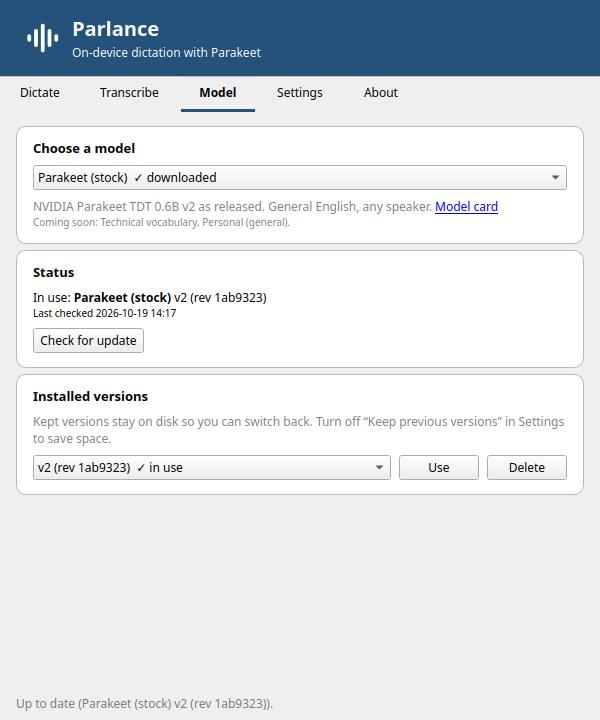
danielrosehill/English-Hebrew-Codeswitching-Sentences: rows tagged code_switchdanielrosehill/Tech-Sentences: rows tagged techThis dataset trains danielrosehill/Parakeet-TDT-0.6B-v2-English-Hebrew-Codeswitching. That model runs on-device in Parlance, the project's dictation app, which offers it alongside stock Parakeet: an Android APK (voice keyboard), an Ubuntu / Debian .deb and a Windows .zip.
Parakeet v1.0
(Jachnun) and a streaming
Nemotron fine-tune
were trained on this dataset at revision 550bfcaa0f84 and scored on 2026-10-19 on its
term-disjoint test split (387 code-switched clips, never trained on). Code-switching WER: stock
Parakeet TDT 0.6B v2 11.3%, PoC-3 6.0%, v1.0 5.1%, Nemotron 5.8% (offline decoding).
Held-out terms written correctly: 25.9%, 45.7%, 47.8% and 44.4%. On the public
English-Hebrew-Codeswitching-ASR-Benchmark,
v1.0 writes 73.3% of the Hebrew terms correctly, against 32.6% for stock v2.

One speaker's voice: every training and test clip is the same speaker, so these numbers rank models on that speaker only. Full results: hebrish.app/benchmarks; all the datasets: hebrish.app/datasets.
| Category | What the sentences contain |
|---|---|
code_switch |
English with everyday Hebrew words written in Latin letters. The spellings follow a single canonical convention. |
names |
Jewish and Israeli first names, surnames and Israeli place names, each with one canonical spelling |
email / message |
Sentences in the style of dictated emails, WhatsApp messages and notes to self. This is the main use case: email dictation on Android. |
tech |
Software, DevOps, cloud and AI vocabulary |
homophone |
Sentences whose context settles which spelling of a homophone is meant |
general |
Everyday spoken English |
target_word / typed |
Sentences generated on demand around one word, or typed in by the speaker |
Where the dataset is meant to grow next, from a voice note by the speaker (2026-10-18; audio, transcript; the full list of ideas is in the model card):
The dataset uses the standard audiofolder layout, so load_dataset("danielrosehill/Read-Aloud-Voice-Sentences")
works directly.
data/train/audio/<id>.wav    16 kHz mono 16-bit PCM
data/train/metadata.jsonl
data/test/...                held-out set, never trained on
The test split is term-disjoint for code_switch and tech. A held-out Hebrew or technical
term never appears in train, so the evaluation measures generalisation to unseen vocabulary.
| Column | Meaning |
|---|---|
text |
Ground-truth transcript: punctuated and cased, to match Parakeet v2's output style |
categories, target_terms |
What the sentence exercises, and which term the evaluation scores |
prompt_source |
Where the sentence text came from (see Licence) |
edited |
true when the speaker corrected the prompt before or after reading it |
duration_s, environment, device, recorded_at |
Recording metadata |
conditions |
Recording conditions noted on the phone (background-noise, recorded-outdoors, in-car, ...); missing on the earliest rows |
hebrew_pronunciation |
israeli, ashkenazi, mixed, or null when not tagged (see Pronunciation handling) |
A row can have several categories (code_switch, tech, names, long, email, message, homophone, general), so one kind of data can be used on its own:
from datasets import load_dataset
ds = load_dataset("danielrosehill/Read-Aloud-Voice-Sentences")
code_switch = ds["train"].filter(lambda r: "code_switch" in r["categories"])
One of the less obvious facets of this kind of code-switching is that the words switched into English do not come from one language with one pronunciation. Some are Modern Hebrew, some are Yiddish, and even within Hebrew there is more than one pronunciation tradition. Modern Israeli Hebrew uses a Sephardi-based pronunciation (Shabbat, Sukkot, brit); many English-speaking Jews use the Ashkenazi pronunciation of the same words, especially religious ones (Shabbos, Sukkos, bris), and one speaker can move between the two in a single conversation. On top of that is the speaker's own accent in English. That makes this a harder target than code-switching with a single donor language.
Methodology. Variants are recorded deliberately: the speaker reads some Hebrew words in more than one pronunciation, so the same term appears in the dataset said in different ways. The transcript follows the sentence's spelling: "Shabbat" read the Ashkenazi way is still written "Shabbat", and only a sentence that spells the Ashkenazi form ("Shabbos") is transcribed that way.
Tagging. For the best results the variants should be tagged, so models can be scored, and the
data balanced, per pronunciation. Since 2026-10-19 each take has a hebrew_pronunciation column:
| Value | Meaning |
|---|---|
israeli |
Modern Israeli (Sephardi-based) pronunciation |
ashkenazi |
Ashkenazi pronunciation |
mixed |
Both within the one take |
| null | Not tagged |
Rows recorded before then are null, except those whose transcript already spells an Ashkenazi form,
which were filled as ashkenazi. Earlier takes that were read in a deliberate variant are still
untagged and will be retro-tagged by listening, so a null does not mean Israeli pronunciation.
prompt_source starts with tatoeba:<id> comes from Tatoeba under
CC-BY 2.0 FR. The id identifies the source sentence: https://tatoeba.org/en/sentences/show/<id>.prompt_source starts with generated: was written for this dataset by the named model. A second model from a
different family then reviewed it for correct Hebrew usage and natural phrasing. It is released under CC-BY-4.0 with the rest of the dataset.prompt_source starts with enron:<message-id number> is a single sentence taken from the Enron email corpus,
which the US Federal Energy Regulatory Commission made public and CMU redistributes. Its licence status is inferred (public record);
it has never been formally licensed. Sentences were filtered and reviewed to exclude names, personal content and identifying details.english-hebrew-mixed-sentences and tech-sentences-for-asr-training comes from the
author's earlier datasets, Hebrish/English-Hebrew-Mixed-Sentences
and danielrosehill/Tech-Sentences-For-ASR-Training, both MIT.